|
Posted: 16 Sep 2014 09:14 AM PDT Bringing some order into the realm of ‘hot Jupiters’ is all to the good. How do these enormous worlds get so close to their star, having presumably formed much further out beyond the ‘snowline’ in their systems, and what effects do they have on the central star itself? And how do ‘hot Jupiter’ orbits evolve so as to create spin-orbit misalignments? A team at Cornell University led by astronomy professor Dong Lai, working with graduate students Natalia Storch and Kassandra Anderson, has produced a paper that tells us much about orbital alignments and ‘hot Jupiter’ formation. It’s no surprise that large planets — and small ones, for that matter — can make their stars wobble. This is the basis for the Doppler method that so accurately measures the movement of a star as affected by the planets around it. But something else is going on in ‘hot Jupiter’ systems. In our own Solar System the rotational axis of the Sun is more or less aligned with the orbital axis of the planets. But some systems with ‘hot Jupiters’ have shown a misalignment between the orbital axis of the gas giants and the rotational axis of the host star.
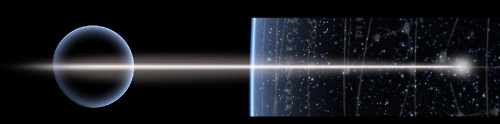
Image: ‘Hot Jupiters,’ large, gaseous planets in inner orbits, can make their suns wobble after they wend their way through their solar systems. Credit: Dong Lai/Cornell University. The Cornell team went to work on simulations of such systems, working with binary star systems separated by as much as hundreds of AU. Their work shows that gas giants can be influenced by partner binary stars that cause them to migrate closer to their star. At play here is the Lidov-Kozai mechanism in celestial mechanics, an effect first described by Soviet scientist Michael Lidov in 1961 and studied by the Japanese astronomer Yoshihide Kozai. The effect of perturbation by an outer object is an important factor in the orbits of planetary moons, trans-Neptunian objects and some extrasolar planets in multiple star systems. Thus the mechanism for moving a gas giant into the inner system, as described in the paper:
As the planet approaches the star, interesting things continue to occur. From the paper:
Moreover, “…in the presence of tidal dissipation the memory of chaotic spin evolution can be preserved, leaving an imprint on the final spin-orbit misalignment angles.” The approach of the ‘hot Jupiter’ to the host star can, in other words, disrupt the previous orientation of the star’s spin axis, causing it to wobble something like a spinning top. The paper speaks of ‘wild precession and wandering,’ a fact that Lai emphasizes, likening the chaotic variation of the precession to chaotic phenomenon such as weather systems. The spin-orbit misalignments we see in ‘hot Jupiter’ systems are thus the result of the evolution of changes to the stellar spin caused by the migration of the planet inward. The paper goes on to mention that we see examples of chaotic spin-orbit resonances in our own Solar System. Saturn’s satellite Hyperion experiences what the paper calls ‘chaotic spin evolution’ because of resonances between its spin and orbital precession periods. Even the rotation axis of Mars undergoes chaotic variation due to much the same mechanism. The paper is Storch, Anderson & Lai, “Chaotic dynamics of stellar spin in binaries and the production of misaligned hot Jupiters,” Science Vol. 345, No. 6202 (12 September 2014), pp. 1317-1321 (abstract / preprint)
|
‘Hot Jupiters’: Explaining Spin-Orbit Misalignment Posted From Centauri Dreams


About The Owl Lady

 Viv Drewa - The Owl Lady