|
Posted: 14 Jan 2016 07:31 AM PST I hadn’t expected a new paper on KIC 8462852 quite this fast, but hard on the heels of yesterday’s article on the star comes “KIC 8462852 Faded at an Average Rate of 0.165±0.013 Magnitudes Per Century From 1890 To 1989,” from Bradley Schaefer (Louisiana State University). Schaefer takes a hard look at this F3 main sequence star in the original Kepler field not only via the Kepler data but by using a collection of roughly 500,000 sky photographs in the archives of Harvard College Observatory, covering the period from 1890 to 1989. The Harvard collection is vast, but Schaefer could take advantage of a program called Digital Access to a Sky Century@Harvard(DASCH), which has currently digitized about 15 percent of the archives. Fortunately for us, this 15 percent covers all the plates containing the Cygnus/Lyra starfield, which is what the Kepler instrument focused on. Some 1581 of these plates cover the region of sky where KIC 8462852 is found. What Schaefer discovers is a secular dimming at an average rate of 0.165±0.013 magnitudes per century. For the period in question, ending in the late 1980s, KIC 8462852 has faded by 0.193±0.030 mag. From the paper:
That’s useful information, especially given the possible objection to the Kepler findings that they might be traceable to a problem with the Kepler spacecraft itself. Evidently not:
As Schaefer notes, KIC 8462852 can now be seen to show two unique episodes involving dimming — the dips described here yesterday for the Kepler spacecraft, and the fading in the Harvard data. The assumption that both come from the same cause is reasonable, as it would be hard to see how the same star could experience two distinct mechanisms that make its starlight dim by amounts like these. The timescales of the dimming obviously vary, and the assumption would be that if the day-long dips are caused by circumstellar dust, then the much longer fading that Schaefer has detected would be caused by the same mechanism.
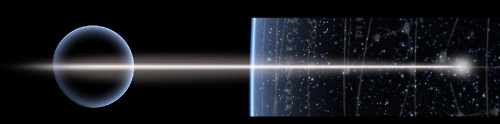
Image: KIC 8462852 as photographed from Aguadilla, Puerto Rico by Efraín Morales, of the Astronomical Society of the Caribbean (SAC). Thus we come to the comet hypothesis as a way of explaining the KIC 8462852 light curves. Incorporating the fading Schaefer has discovered, a cometary solution would require some mind-boggling numbers, as derived in the paper. From the summary:
If Schaefer’s work holds up, the cometary hypothesis to explain KIC 8462852 is deeply compromised. We seem to be looking at the author calls “an ongoing process with continuous effects” around the star. Moreover, it is a process that requires 104 to 107 times as much dust as would be required for the deepest of the Kepler light dips. And you can see in the quotation above Schaefer’s estimate for the number of giant comets this would require, all of them having to pass in front of the star in the last century. The paper is Schaefer, “KIC 8462852 Faded at an Average Rate of 0.165+-0.013 Magnitudes Per Century From 1890 To 1989,” submitted to Astrophysical Journal Letters (abstract).
|
Centauri Dreams: KIC 8462852: A Century Long Fade?


About The Owl Lady

 Viv Drewa - The Owl Lady